How to Get Legal Documents Translated: Certified vs. Notarized
To get a legal document translated for USCIS, you generally need a complete English translation along with a signed certification from the translator. The certification confirms that the translation is complete and accurate and that the translator is competent to translate from the original language into English.
For USCIS, that is generally all that is required for the translation itself. Courts, consulates, universities, and other organizations may have additional requirements, such as notarization, an apostille, or a specific translator credential.
The order is important, too. If you notarize, apostille, or otherwise prepare a document before confirming the receiving organization’s requirements, you may end up having to redo the process and pay twice.
What Documents Need to Be Translated for USCIS?
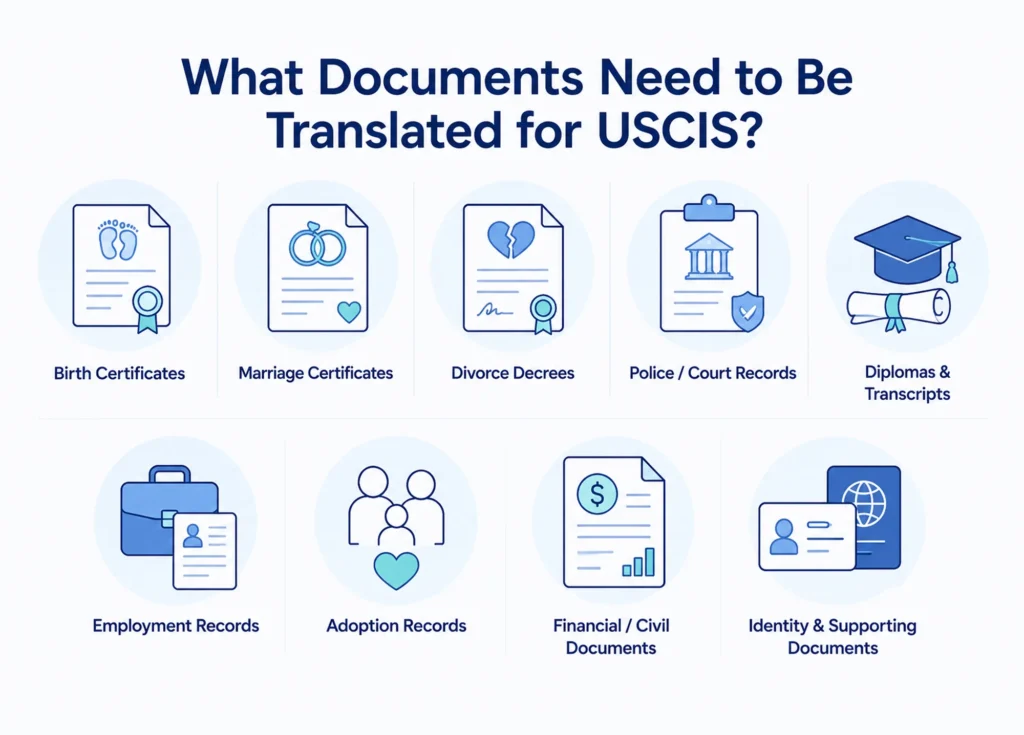
USCIS generally requires a full English translation of any document that is not written entirely in English and that you submit as evidence with your immigration application or petition.
Documents that may require translation include:
- Birth certificates
- Marriage certificates
- Divorce decrees
- Police or court records
- Diplomas and academic transcripts
- Employment records
- Adoption records
- Financial or civil documents
- Identity documents and other supporting evidence
You do not usually need to translate a document that is already entirely in English. If a document contains both English and another language, the translation requirement may depend on how much relevant information appears in the other language.
When a translation is required, it should cover the entire document rather than only the sections you believe USCIS needs to review. A complete translation helps ensure that all relevant information is available to the officer reviewing your case and can help prevent delays or requests for additional evidence.
How Do You Get a Legal Document Translated?
To get a legal document translated, you need to first confirm the receiving organization’s requirements. You then need to provide a complete copy of the document to a competent translator, have it fully translated and certified, and add notarization or an apostille only if required.
1. Ask the Receiving Institution What It Requires
Before ordering a translation, you need to confirm exactly what the organization receiving your document requires.
Ask:
- Do you need a certified translation, notarization, an apostille, or more than one?
- Do you need to submit a digital PDF or a physical copy?
- What is the submission deadline?
Requirements can vary between USCIS, courts, consulates, universities, and other organizations. Confirming them first can help you avoid paying for services you do not need.
2. Prepare a Readable Copy of the Document
You need to provide a complete, legible copy of the document you want translated. Keep the original available in case the receiving organization asks for it.
Make sure the copy includes every page, including pages with stamps, seals, handwritten notes, signatures, or information on the back.
3. Have the Entire Document Translated
You need to have the entire document translated from the original language into English.
The translation should include information that may seem minor, such as official stamps, seals, marginal notes, and handwritten annotations. If something cannot be read, the translator should identify it as illegible rather than leave it out.
4. Attach the Translator’s Certification
For a USCIS submission, you need to include a translator’s certification with the English translation.
The certification must confirm that the translation is complete and accurate and that the translator is competent to translate from the original language into English. The translator should sign the certification.
5. Add Notarization or an Apostille Only If Required
You do not automatically need notarization or an apostille for a translated legal document.
If the receiving organization requires one, you need to confirm which document must be notarized or authenticated and follow its specific requirements.
Who Is Allowed to Translate a Legal Document?
For USCIS, you do not need to use a specific translation company or an “USCIS-approved translator.” You need a translator who is competent in both languages and can provide the required certification.
What Does USCIS Actually Require?
Under 8 CFR 103.2(b)(3), you need to submit a complete English translation with any foreign-language document submitted to USCIS. The translator must certify that the translation is complete and accurate and that they are competent to translate from the original language into English.
Why “USCIS-Approved Translator” Can Be Misleading
You do not need to find a translator from an official USCIS-approved vendor list. USCIS focuses on whether the translation meets its requirements and includes the appropriate translator certification.
If a company claims to be an “USCIS-approved translator,” be careful about what that claim actually means. The important question is whether the translation meets USCIS’s requirements and includes the appropriate translator certification.
Can You Translate Your Own Documents?
You may be able to translate your own documents, but using an independent translator can be the safer option for important immigration documents. An independent translator can help address potential concerns about accuracy, completeness, or impartiality. Because you are an interested party in this case, a translation prepared by you may not be accepted by the receiving authority.
When a Court or Consulate Wants More Than USCIS Does
You cannot assume that USCIS requirements apply to every organization. Courts, consulates, universities, and foreign authorities may require notarization, specific translator credentials, or other forms of certification. Always confirm the requirements with the organization receiving your document.
Which Parts of the Document Have to Be Translated?

You need to have the entire document translated, including details that may seem minor or irrelevant. Leaving out stamps, notes, or other information can make the translation incomplete and create problems during review.
This includes:
- Official stamps and seals
- Marginal notes and annotations
- Handwritten information
- Signatures and other markings
- Information printed on the back of the document
- Tables, headings, and other document elements
- Sections that are difficult to read
If part of the original document is illegible, the translator should indicate that it is illegible rather than leave the section out.
What Documents Commonly Need Legal Translation?
Depending on why you need the translation, you may need to translate documents such as:
- Birth certificates
- Marriage and divorce certificates
- Death certificates
- Police clearances
- Academic transcripts and diplomas
- Passports and national IDs
- Adoption records
- Bank statements
- Powers of attorney
- Court judgments
At Rush In Documentation, we translate a wide range of legal, personal, and immigration documents while paying attention to the details that appear throughout the original. A complete translation should cover the document as a whole so the receiving organization can review all of the information contained in it.
Do You Need Notarization, an Apostille, or Both?
You may need notarization, an apostille, or both, depending on the requirements of the organization receiving your document and where the document will be used.
Notarization generally verifies the translator’s signature or identity, rather than the accuracy of the translation itself. An apostille authenticates a public document for use in another country. Because they serve different purposes, one does not automatically replace the other.
If you are unsure which service you need, confirm the requirements with the receiving organization before ordering additional services.
Translate First, or Apostille First?
You may need to apostille the original document before translating it, or translate and certify the document before obtaining an apostille, depending on the destination country and the requirements of the receiving authority.
In some cases, the original document must be apostilled first and translated afterward. In other situations, the translation may need to be notarized before an apostille can be issued for the translated document.
There is no universal order that applies to every document. You should confirm the required process with the receiving authority before you begin. Completing the steps in the wrong order could mean starting over and paying for the process again.
What Can Make Your Translation Get Rejected?
Your translation can be rejected or sent back if it is incomplete, incorrectly certified, or does not meet the receiving organization’s requirements. Here are three issues you should check before submitting it.
1. Using One Blanket Certificate for Unrelated Documents
If you are translating several unrelated documents, do not assume that one general certification will satisfy every requirement. A separate certification for each document may be necessary, particularly when the documents are being submitted for different purposes.
Fix: Ask the receiving organization whether it accepts one certification covering multiple documents or requires a separate certification for each translation.
2. Using Machine Translation or an Unacceptable Foreign Certification
Machine translation may miss legal terminology, names, stamps, handwritten notes, and other details that need to appear accurately in the final document.
Another potential problem is having a translation completed abroad and certified or notarized under a foreign procedure that the receiving organization does not accept.
Fix: Use a competent translator who understands the requirements of the organization receiving the document and confirm what type of certification is required before the translation is completed.
3. Submitting the Translation Without the Original
A translated document should not be treated as a replacement for the original document. Some organizations need to see the original or a copy of it alongside the translation.
Fix: Keep a complete copy of the original document and submit it together with the translation whenever the receiving organization requires it.
What Does It Cost and How Long Does It Take?
The cost of legal document translation depends on the language, document length, turnaround time, and any additional services you need, such as notarization or an apostille.
At Rush In Documentation, standard certified translations typically take 2-4 business days, while rush translations take 1-2 business days. Same-day service is also available for urgent cases. Please, contact us before placing an order for urgent translation
Final Checklist Before You Submit
Before submitting a translated legal document, make sure you have:
- A complete translation of the original document
- The required translator certification
- Any notarization specifically requested by the receiving organization
- An apostille if the destination authority requires one
- A copy of the original document
- Enough time for any government authentication or processing
Most importantly, confirm the requirements before ordering additional services. Having the right translation is only part of the process. Following the correct order can help you avoid unnecessary delays and additional costs.
Frequently Asked Questions
Do I need to translate my birth certificate for USCIS?
Yes, if your birth certificate is not entirely in English and you are submitting it to USCIS. You need to provide a complete English translation with the required translator certification. The translation should include the entire document, including stamps, seals, and other relevant information.
Can a family member translate my documents?
USCIS does not require you to use a specific translation company or approved vendor. The translator must be competent in both languages and provide the required certification. For important immigration documents, using an independent translator can help ensure the translation is complete and accurate.
Is a notarized translation the same as a certified translation?
No. A certified translation and a notarized translation serve different purposes. A certified translation includes the translator’s statement that the translation is complete and accurate and that they are competent to translate it. Notarization link to generally verifies the translator’s signature or identity, not the accuracy of the translation.
Do universities accept the same translation USCIS accepts?
Not necessarily. Universities can set their own requirements for translated documents and may require specific certifications, formats, or translator credentials. You should check the requirements of the university or registrar before ordering the translation.
Can a document be translated and apostilled together?
Sometimes, but it depends on the document and where you will use it. An apostille authenticates a public document for use in another country, while a translation addresses the language requirement. In some cases, you need to apostille the original before translating it; in others, the translation may need certification first.
How do I get a Russian or Ukrainian document translated for use in the United States?
First, confirm the receiving organization’s requirements. Then provide a complete, legible copy of the document to a competent translator and make sure the translation includes the required certification. Names, patronymics, stamps, and Cyrillic transliteration should be translated carefully and kept consistent with the original.
__________
This article provides general information about document translation requirements and is not legal advice. Requirements can vary by agency, court, consulate, university, or destination country. Confirm the current requirements with the organization receiving your documents.