How to Get a Single Status Affidavit Apostilled for Use Abroad

When you’re planning to get married abroad, relocate, apply for an international visa, or handle legal matters in another country, you may be asked to prove that you’re not currently married. That’s where a single status affidavit comes in.
However, if you need to use this document outside the United States, you can’t just show a notarized affidavit and call it a day. In most cases, you’ll need to get your single status affidavit apostilled for use abroad so foreign authorities can recognize it as valid.
What Is a Single Status Affidavit?
A single status affidavit is a sworn legal statement that declares your current marital status as unmarried. Think of it as an official confirmation from you, under oath, that you are not currently married and have no legal spouse. This document is commonly required when you’re relocating to another country, applying for a visa that requires marital status verification, planning an international wedding, or handling inheritance or property matters abroad.
The affidavit is not a marriage certificate or divorce decree; it’s your personal declaration supported by your signature and a notary’s seal. The document typically includes your full legal name, date of birth, current residence, and a statement affirming that you have never been married or that any previous marriages have been legally dissolved. Some countries require this document specifically because it represents your current legal status at a particular moment in time.
Why You Need an Apostille
An apostille authenticates your single status affidavit for use in countries that are signatories to the Hague Apostille Convention of 1961. This international treaty, signed by over 140 countries, established a simplified system for certifying the origin of public documents. Without an apostille, foreign officials have no way to verify that your document is legitimate or that the notary who signed it was authorized to do so.
Countries that are not part of the Hague Convention may require different authentication methods, such as legalization through an embassy or consulate. However, most developed nations and many others have signed the treaty, making the apostille the standard and most efficient solution for international document authentication.
How to Obtain a Single Status Affidavit for Use Abroad
Before you can get an apostille, you need to have a single status affidavit prepared and notarized. Here’s how to do this:
Find a Notary Public
Start by locating a notary public in Los Angeles (or your state). You can find notaries through your bank, law office, local government office, or online directories. Many states have searchable notary databases on their Secretary of State websites. Some FedEx Office locations and UPS stores also offer notary services. Call ahead to confirm they’re available and ask about their fees, which typically range from $5 to $25 per signature.
Prepare Your Affidavit
You can either use a template or create your own statement. The affidavit should include your full legal name, current address, date of birth, and a clear statement that you are single and have never been married or that your previous marriages have been legally dissolved. If you were previously married, include the date of divorce or annulment and the state where it was finalized. Be precise and factual; any errors could cause problems when foreign officials review the document.
Have It Notarized
Bring your completed affidavit, along with a valid photo ID, to the notary public. The notary will verify your identity, have you sign the document in front of them, and then apply their official seal. The notary’s seal, signature, and stamp make the document official. Some notaries may suggest specific wording or require you to swear or affirm the truth of your statement, which is a standard part of the notarization process. Ask for the notary’s commission number and seal to be clearly visible on the document.
Step-by-Step Process for Getting an Apostille
Once you have a notarized single status affidavit, follow these steps to get it apostilled:
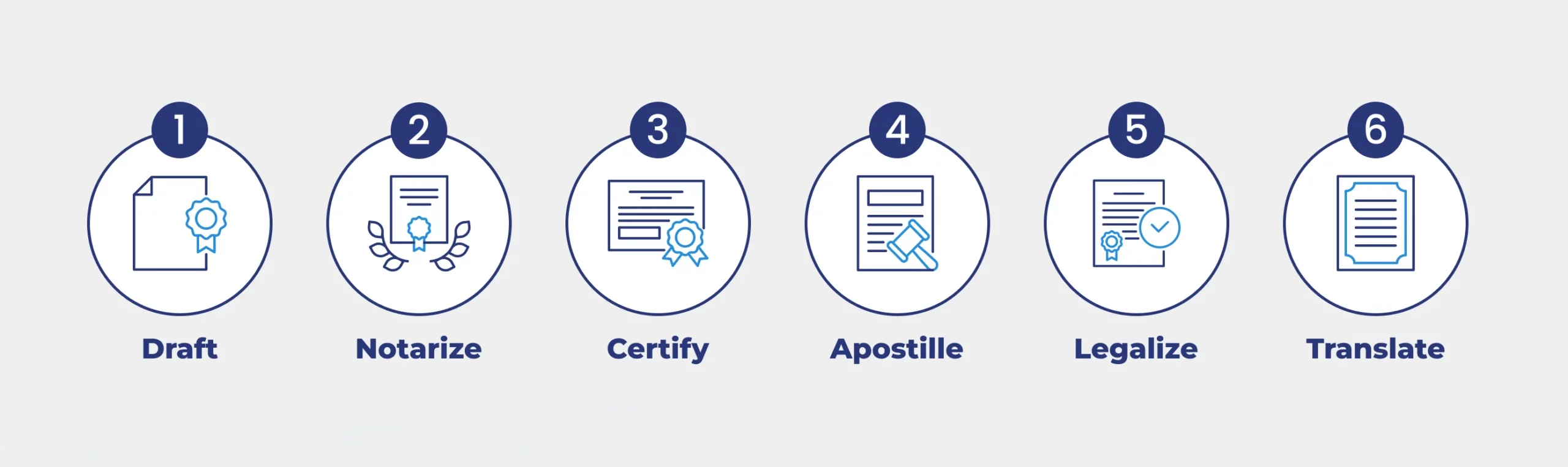
Step 1: Draft the Affidavit
The first step is to create your single status affidavit. You can draft this yourself or use a template provided by an attorney or notary. The document should include specific information presented in a clear, formal manner.
Your affidavit should begin with a header stating “Affidavit of Single Status” or “Affidavit Regarding Marital Status.” Include your full legal name exactly as it appears on your government-issued ID, your complete date of birth, your current mailing address, and any previous addresses if you’ve lived in the state for less than five years.
The body of the affidavit should include a clear declaration such as: “I hereby declare under penalty of perjury that I am not currently married, that I have never been married” (if applicable), or “that my previous marriage to [spouse’s name] was dissolved by divorce on [date] in [state/country].”
If you have been married before, provide specific details about the dissolution of each marriage. End with a signature line, a date line, and a notary acknowledgment section.
Step 2: Get It Notarized
Once your affidavit is drafted, take it to a notary public to have it notarized. You can find notaries through your bank, law office, local government office, or online directories. Many states have searchable notary databases on their Secretary of State websites. FedEx Office locations, UPS stores, and some title companies also offer notary services. Call ahead to confirm availability and ask about their fees, which typically range from $5 to $25 per signature.
Bring your completed affidavit and a valid photo ID to the notary appointment. The notary will verify your identity, have you sign the document in front of them, and then apply their official seal. The notary’s seal, signature, commission number, and commission expiration date make the document official. Ask the notary to ensure all elements are clearly visible and legible on the document.
If you’re currently living abroad, you can have your affidavit notarized at a U.S. embassy or consulate in your country of residence. This carries additional weight for international use. Contact the nearest U.S. embassy or consulate to schedule a notarization appointment and ask about their fees and required documentation.
Step 3: Obtain State or County Certification (If Required)
In some U.S. states, you may need to obtain a state or county certification of the notary’s authority before requesting an apostille. This step verifies that the notary was properly commissioned at the time they notarized your document. Not all states require this, but it’s worth checking with your Secretary of State office.
To determine if this step applies to you, contact your state’s Secretary of State office and provide the notary’s name and commission number. If required, you’ll typically need to submit the notarized affidavit along with a request form and a small fee (usually $5-$15). The state will issue a certification confirming the notary’s authority, which you’ll then include with your apostille request.
Step 4: Request the Apostille
The apostille must be issued by the same state authority that authorized the notary who signed your document. In most cases, this is your state’s Secretary of State office, although some states delegate apostille services to other offices, such as the Attorney General’s office or the Clerk of the Superior Court. Check your state’s Secretary of State website to confirm the correct office and any specific requirements they have.
You have several options for submitting your apostille request. Many states allow you to submit requests in person at their office. This is the fastest option if you live nearby; you may receive your apostille the same day or within a few hours. Mail-in requests typically take 1-3 weeks, depending on the state and processing volume.
You’ll need the original notarized single status affidavit, though some states accept certified copies. Contact the apostille office in advance to confirm their specific requirements. Apostille fees vary by state but typically range from $10 to $30 per apostille. Some states offer rush processing for an additional fee if you need your apostille quickly.
Step 5: Legalization for Non-Hague Countries
If you’re using your single status affidavit in a non-Hague Convention country, you’ll need to go through a legalization process instead of (or in addition to) obtaining an apostille. This process involves multiple steps and can take significantly longer.
First, you’ll need to obtain an apostille from your state. Then, submit your apostilled document to the U.S. Department of State’s Office of Authentications in Washington, D.C., for federal authentication. This process typically takes 1-2 weeks and costs around $30-$35. After federal authentication, you’ll send your document to the consulate or embassy of the destination country. They will review your document and apply their legalization stamp, confirming its validity for use in their country. This final step typically takes 1-3 weeks and may cost $50-$200, depending on the country.
Throughout this process, keep your documents in pristine condition; do not fold, crease, or laminate them, as damage can complicate the legalization process.
Step 6: Translation and Final Use
If your destination country’s official language is not English, you’ll likely need to have your single status affidavit translated by a certified translator. This translation should be done after your document has been apostilled or legalized. The translator will provide a certified statement confirming the accuracy of the translation.
Translation typically costs $50-$200, depending on the complexity of the document and the translator’s rates. Many certified translators are available online and can work with scanned documents. Some destination countries may have specific translation requirements, such as requiring translations from state-approved translators. Check with your destination country’s embassy or the organization requesting the document to confirm their translation requirements.
Once your document is apostilled (or legalized), translated if necessary, and any final certifications are complete, it’s ready for use. Keep the original and all certified copies in a safe location, as obtaining replacements can be time-consuming and costly.

Country-Specific Guidelines
While the core steps are similar everywhere, the exact requirements to get a single status affidavit apostilled for use abroad can vary depending on where you’re from and where you’re going. Below are some practical, high-level guidelines to help you plan.
United States
If you are a U.S. citizen, your journey almost always begins at the state level:
- Your single status affidavit is notarized in the state where you sign it.
- The apostille is issued by that same state’s competent authority (usually the Secretary of State).
Most states issue apostilles within 1-3 weeks for mail requests and same-day or next-day for in-person requests. Some states, such as California, Texas, and New York, handle high volumes of apostille requests and may have longer processing times. Consider using expedited services if available in your state or submitting your request in person if you’re located nearby.
Federal apostilles are rarely needed for single status affidavits, as state-issued apostilles are recognized internationally. However, if your affidavit will be used in multiple countries or for federal purposes, confirm with your destination country whether a state or federal apostille is required.
United Kingdom and EU Countries
If you’re a U.S. citizen marrying in the UK or EU, your U.S. single status affidavit with a U.S. apostille is generally accepted. However, some countries within the EU may have specific requirements. For example, Spain and Italy have special forms they prefer for marriage documentation. Contact the specific registry office or courthouse in your destination country to confirm whether they accept a U.S. single status affidavit or require a country-specific certificate.
UK citizens and residents obtaining a Certificate of No Impediment should work with their local registry office or church. This document is recognized throughout the EU and most Hague Convention countries without an additional apostille. However, if a UK citizen is marrying in the U.S., the reverse process applies; they would need their UK certificate apostilled from the appropriate UK authority.
Non-Hague Convention Countries
For non-Hague countries in the Middle East, Asia, and Africa, the legalization process is essential. After obtaining your U.S. apostille, you must submit your document through the U.S. Department of State for federal authentication, followed by legalization through the destination country’s embassy. This two-step process can take 4-6 weeks total. Plan accordingly and submit your documents early to avoid delays in your international plans.
Some non-Hague countries may also require that your affidavit be notarized at a U.S. embassy or consulate rather than by a local notary. Before starting the process, contact the destination country’s embassy or consulate in the United States to confirm their specific requirements.
Checklist Before Submission
Before you submit your single status affidavit for apostille, use this checklist to ensure you have everything in order:
Document Preparation
- Affidavit clearly titled (Affidavit of Single Status)
- Full legal name, date of birth, and address included
- Marital status statement is clear and accurate
- Divorce/annulment details included (if applicable)
Notarization
- Signed in front of a notary
- Notary seal is dark, clear, and fully visible
- Notary’s signature, commission number, and expiration date included
State/County Certification (If Required)
- Checked Secretary of State requirements
- Obtained notary commission certification (if needed)
Apostille Request
- Correct state authority identified
- Request form completed
- Fee prepared (check, money order, or card)
- Copies of all documents kept for your records
Translation (If Required)
- Confirmed language and translator requirements
- Translation ordered after apostille/legalization
- Translator’s certification statement obtained
Non-Hague Legalization (If Applicable)
- U.S. Department of State authentication requested (if required)
- Embassy/consulate legalization requested
- All original and stamped documents kept together
FAQs
What is a single status affidavit used for?
A single status affidavit is a sworn statement confirming you’re not currently married. It’s commonly used for marriage abroad, international adoption applications, immigration visas requiring marital status verification, inheritance or property matters crossing borders, and certain employment or residency applications in foreign countries. The document provides legal proof of your single status at the time it was notarized.
How long is a single status affidavit valid?
The validity period depends on your destination country’s requirements. Generally, most countries accept affidavits dated within the past three to six months. Some countries may accept older affidavits if your marital status hasn’t changed, but to be safe, obtain a new affidavit if yours is more than six months old. Always check your specific destination country’s requirements before submitting a document.
Can I apostille a single status affidavit from abroad?
Yes, absolutely. If you’re living overseas, you can have your affidavit notarized at a U.S. embassy or consulate in your country of residence. Then, you can request an apostille from your home state’s Secretary of State office by mail or through an online system if available. Many states accept mail requests from abroad, though processing times may be slightly longer. Alternatively, you can use an apostille service provider who will submit your request on your behalf and mail your apostilled document to you internationally.
What’s the difference between an apostille and legalization?
An apostille is used for countries that are signatories to the Hague Apostille Convention. It’s a simplified, one-step authentication process that confirms the document’s origin and the notary’s authority. Legalization is for non-Hague Convention countries and involves a multi-step process: obtaining an apostille, then submitting to the U.S. Department of State for federal authentication, and finally having the destination country’s embassy legalize the document. Legalization is more time-consuming and expensive, but is required for countries that don’t recognize apostilles.
Do I need to translate the affidavit?
Yes, if your destination country’s official language is not English, a certified translation is typically required. The translation should be completed after your document has been apostilled or legalized. A certified translator will provide a statement confirming the accuracy of the translation. Some countries have specific translator requirements, so confirm with your destination country’s embassy or the organization requesting the document before arranging translation.
How much does the entire process cost?
Costs vary depending on the steps involved. Notarization typically costs $5-$25. An apostille usually costs $10-$30. State or county certification, if required, costs $5-$15. If legalization is needed, federal authentication through the U.S. Department of State costs around $30-$35, and embassy legalization can cost $50-$200. Certified translation, if needed, typically costs $50-$200. In total, you might spend $100-$500, depending on whether you need an apostille only or the full legalization and translation process.
How long does the entire process take?
Timeline varies based on submission method. In-person apostille requests can be completed within hours or a single business day. Mail-in requests typically take 1-3 weeks. For non-Hague countries requiring legalization, add 1-2 weeks for federal authentication and 1-3 weeks for embassy legalization, totaling 3-6 weeks or more. Plan and submit your requests early to avoid delays in your international plans.
What if I made a mistake on my affidavit?
If you notice an error after notarization, you cannot cross out or correct it. Instead, obtain a new single status affidavit with the correct information and have it notarized again. Submit the corrected version for apostille. Mistakes on legal documents can cause rejection by foreign authorities, so it’s better to start fresh with accurate information.
Can I get multiple apostilles for the same affidavit?
Yes, you can request multiple apostilles for the same notarized affidavit. This is useful if you need your document recognized in multiple countries. Make sure you cooperate with a trustworthy apostille service provide r.
Also, if all destination countries are Hague Convention signatories, one apostille typically serves all of them. Non-Hague countries may require separate legalization processes, but you only need one apostille attached to your document.

Need Help Getting Your Single Status Affidavit Apostilled?
Don’t risk delays in your international plans or costly mistakes in document preparation. Navigating the apostille process, especially when you’re unfamiliar with the requirements of your specific destination country, can be overwhelming. Our expert team specializes in helping people like you prepare, notarize, and apostille single status affidavits quickly and correctly.
We provide comprehensive assistance, including draft review, notarization coordination, apostille request submission, legalization services for non-Hague countries, and certified translation arrangements. Whether you’re getting married abroad, applying for an international visa, or handling cross-border legal matters, we ensure your documents meet all requirements and reach you in time for your important milestone.
Contact us today for a free consultation about your specific situation. We’ll assess your destination country’s requirements, provide a clear timeline and cost estimate, and handle the entire process so you can focus on your plans. With our professional service, you can have confidence that your single status affidavit will be accepted by foreign authorities without complications or delays.