What Is a Mobile Notary? (Definition, Costs & How to Hire One)

Every year, more than 1.25 billion documents are notarized in the USA, and with over 4.4 million commissioned notary publics. The notarization of documents has proven to be one of the most relied-upon fraud prevention methods for all types of legal and financial transactions.
The demand for mobile notary services has grown rapidly as people need faster and more flexible document signing. Real estate closings, health directives, and loan signings often require same-day or after-hours appointments, leading more clients to search for convenient mobile notary options.
What is a Mobile Notary?
A mobile notary is a notary public authorized by the state, who travels to your location for the notarization of your documents.
Instead of going to a bank, shipping store, or a lawyer’s office, the mobile notary comes to your home, office, hospital, assisted living, or any other location of your choice to notarize your documents.
It has the exact same authority and legal standing as any other notary public. The only difference is the flexibility and convenience of the mobile notary.
How Does a Mobile Notary Service Work?

It’s a very organized and simple process. First, you schedule a time to meet, and you inform the notary about the details of the documents, the number of people signing, and the time and place you want to meet. The notary will inform you about the fees that apply.
When the notary meets you, the individuals signing the documents must present identification. The notary will witness the signing of the document and apply the official notary seal.
It usually takes about 15 to 30 minutes for the notary to finish the task, depending on the number of people signing the document.
How Much Does a Mobile Notary Cost?
Each state regulates the amount a notary is allowed to charge for a signature, which is usually between $5 and $20, depending on the location. For example, in California mobile notary charges are capped at $15 per signature, but can quickly become a $40-$150+ appointment based on location, time of day, urgency, etc.
Mobile notary fees usually include two parts: a notarization fee and a travel fee. The notarization fee is set by the state, while the travel fee covers the notary coming to your location. The travel cost may depend on the distance, time of day, and location. In most cases, a full mobile notary appointment costs between $75 and $200.
What Types of Documents Can a Mobile Notary Notarize?
Mobile notaries can notarize many types of documents as long as the notarization follows state laws and the signer appears in person with valid identification.
Real Estate & Loan Documents
One of the most common uses of mobile notary services is for real estate documents. These include mortgage loan packages, refinancing documents, deeds of trust, grant deeds, seller packages, and escrow paperwork. Because these signings often have strict deadlines and require multiple signatures, lenders and title companies often use mobile notaries for convenience and accuracy.
Legal & Personal Documents
Mobile notaries regularly notarize
- powers of attorney
- living wills
- advance healthcare directives
- affidavits
- sworn statements
- guardianship documents
- consent forms, etc.
Moreover, hospital and senior care facility signings are especially common in this category.
Business & Financial Documents
Corporate resolutions, partnership agreements, vendor contracts, financial affidavits, and compliance forms may also require notarization. Businesses often use mobile notaries when multiple executives must sign at a specific location.
It’s important to remember that a mobile notary does not prepare legal documents or provide legal advice unless they are also a licensed attorney. Their role is limited to identity verification and proper completion of the notarial act.
What a Mobile Notary Cannot Do
Knowing the legal limits of a mobile notary is just as important as knowing what they can do. Notaries must follow strict state laws, and breaking these rules can invalidate documents or lead to legal penalties. Being aware of these limits helps prevent delays, rejected paperwork, and costly mistakes.
They Cannot Notarize Without the Signer Present
In almost all states, personal appearance is mandatory. This means the signer must be physically present before the notary at the time of notarization. A notary cannot notarize a document over the phone, based on a photocopied ID, or because someone “vouches” for the signer without following proper legal procedures.
Even if the document has already been signed, the notary must either witness the signing or receive a direct acknowledgment from the signer that the signature is theirs. Without this step, the notarization is not legally valid. This requirement protects against fraud, identity theft, and forged signatures.
They Cannot Proceed Without Proper Identification
A notary must verify identity according to state-approved guidelines. This usually requires an unexpired, government-issued photo ID such as a driver’s license, passport, or state identification card.
If identification is expired, damaged, or does not match the name on the document, the notary is legally required to refuse the notarization. Some states allow credible witnesses under specific circumstances, but strict rules apply.
This rule protects both parties. It ensures the person signing the document is exactly who they claim to be.
They Cannot Give Legal Advice
A mobile notary is not automatically an attorney. Unless the notary is separately licensed to practice law, they cannot interpret legal documents, explain legal consequences, or recommend which type of notarization you need.
For example, if your document does not specify whether it requires an acknowledgment or a jurat, the notary cannot choose for you. Selecting the wrong notarial act can invalidate the document. In such cases, you must consult the document preparer or an attorney.
Notaries are neutral public officials. Their role is to verify identity and complete the notarial certificate, not to guide legal decisions.
They Cannot Notarize Incomplete Documents
If a document contains blank spaces, missing pages, or incomplete sections that could later be altered, the notary may refuse to proceed. Notarizing incomplete paperwork increases the risk of fraud or unauthorized changes after signing.
Before your appointment, ensure the document is fully prepared and ready for signature.
They Cannot Act Outside Their Commissioned State
A mobile notary’s authority is limited to the state in which they are commissioned. They cannot cross state lines and perform notarizations unless they also hold a valid commission in that state.
For example, a California-commissioned notary cannot legally notarize documents in Nevada unless separately commissioned there.
They Cannot Override State Law or Document Requirements
Certain documents require witnesses in addition to notarization. Some documents may not be eligible for notarization at all under state rules. A mobile notary must follow state statutes, even if a client insists otherwise.
These limitations are not inconveniences, they are safeguards. They protect the validity of your document, prevent fraud, and ensure the notarization will be legally recognized.

When Should You Hire a Mobile Notary?
A mobile notary is useful when convenience or mobility matters. This is especially helpful if someone cannot travel to a notary office, needs documents signed outside normal business hours, or requires a private location for multiple signers.
Common situations where mobile notaries are used include real estate closings, hospital signings, senior living facilities, corporate document signings, and urgent legal paperwork.
If you can visit a bank or shipping center during regular business hours, a traditional notary may be a cheaper option. But when convenience and flexibility are more important, hiring a mobile notary is often the best choice.
How to Hire a Reliable Mobile Notary
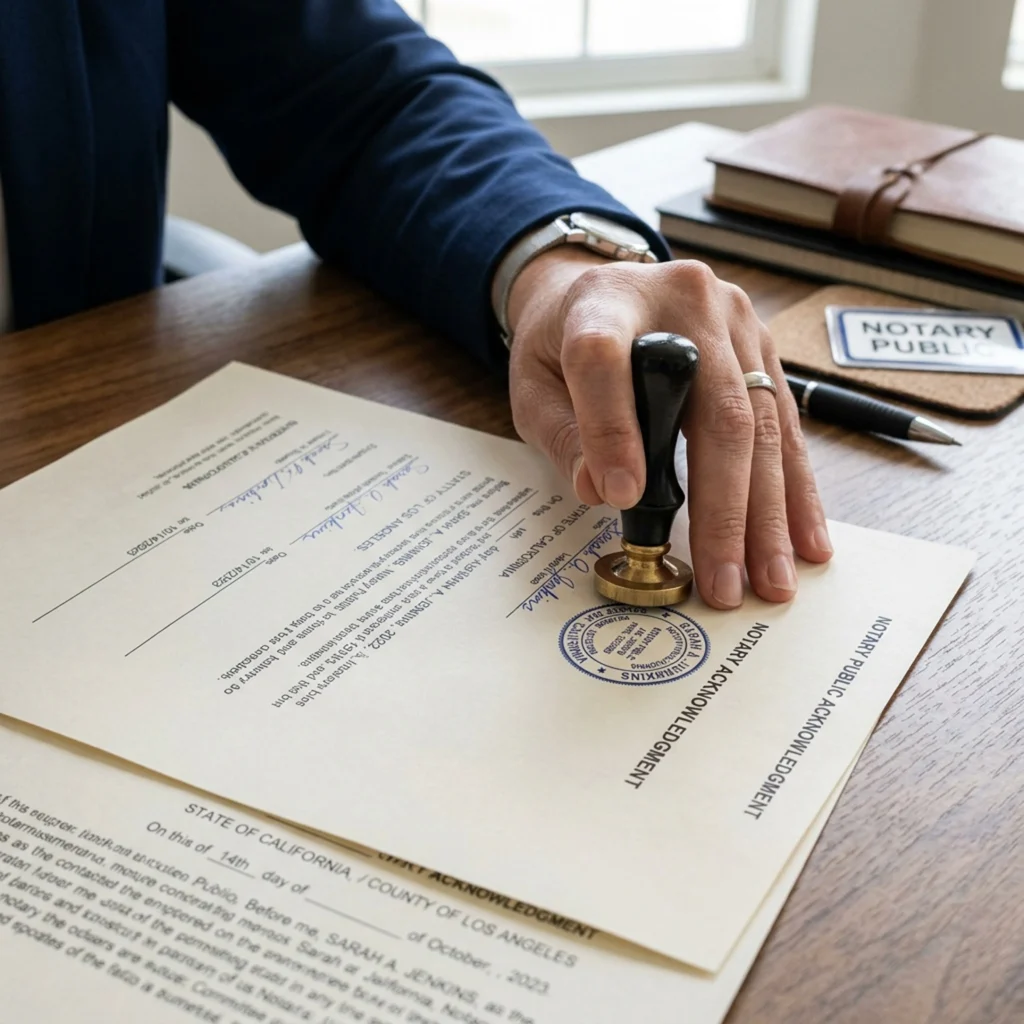
Choosing the right mobile notary is not only about convenience. It also helps ensure your documents are valid and accepted by banks, courts, title companies, and government agencies. If notarization is done incorrectly, it can cause delays, rejected paperwork, or extra costs. Taking a few minutes to choose the right notary helps your appointment go smoothly and your documents get completed properly.
Verify Commission & Credentials
The first step is to confirm that the notary is actively commissioned in your state. In most states, notary commissions are issued and monitored by the Secretary of State, and you can check a notary’s status in the official state database.
If your documents involve real estate, refinancing, or large financial transactions, ask whether the notary has experience with loan signings. Loan packages can include 100+ pages and require careful attention to signatures and initials. An experienced signing agent can guide the process while making sure everything is completed correctly.
You can also ask if the notary has Errors & Omissions (E&O) insurance. This type of insurance is not required in every state, but it provides extra protection, especially for complex transactions.
Confirm Pricing in Advance
Mobile notary pricing can vary based on location, urgency, and document type. Before confirming the appointment, request a clear breakdown of fees.
Ask specifically:
- What is the per-signature notarization fee?
- What is the travel fee?
- Are there additional charges for after-hours, weekends, hospitals, or loan packages?
- Is there a cancellation fee?
Professional notaries provide transparent pricing upfront. Avoid vague estimates or unclear terms. A written confirmation by text or email helps prevent misunderstandings.
Remember, the lowest price is not always the best choice, especially for high-value documents like real estate closings or power of attorney forms.
Evaluate Communication & Professionalism
The way a mobile notary communicates before the appointment often reflects how the signing will go. Professional notaries respond promptly, ask clear questions about the documents, confirm identification requirements, and explain the process in a straightforward manner.
For time-sensitive transactions, punctuality is critical. Late arrivals can delay closings or filing deadlines.
Read Reviews & Check Reputation
Online reviews can help you understand if a notary is reliable and professional. Focus on overall patterns rather than a single negative comment. Consistent feedback about punctuality, accuracy, and professionalism is usually a good sign.
For real estate transactions, title companies and escrow officers often prefer notaries who have a strong reputation for accuracy and efficiency.
Confirm Experience With Your Specific Document Type
Not all notarizations are the same. A simple affidavit is very different from a full mortgage loan package. Hospital signings often require patience and care, while corporate signings may involve several executives and tight schedules.
When scheduling an appointment, briefly explain the type of document you need notarized. A professional mobile notary should quickly understand the request and confirm they can handle it.
Ensure Proper Identification & Witness Requirements Are Clear
Before the appointment, confirm what type of identification is acceptable under state law. If your document requires witnesses, clarify whether you must provide them or whether the notary can arrange for witnesses if allowed.
This step prevents rescheduling and ensures the signing can be completed in one visit.
Frequently Asked Questions About Mobile Notary Services
Even after understanding how mobile notary services work, many people still have practical questions. Below are clear answers to the most common concerns.
Can I Book a Same-Day Mobile Notary Appointment?
Yes. Many mobile notaries offer same-day appointments, especially for urgent documents such as real estate closings, powers of attorney, or loan signings. Availability usually depends on location, travel distance, and the time of day.
Can a Mobile Notary Come to a Hospital or Nursing Home?
Yes. In fact, hospitals, rehabilitation centers, and assisted living facilities are among the most common locations for mobile notarizations. These appointments often involve powers of attorney, healthcare directives, or other urgent legal documents.
However, the signer must be mentally aware and willing to sign. If the signer is heavily medicated, unconscious, or unable to communicate clearly, the notary is legally required to refuse the notarization.
Can a Mobile Notary Notarize at Night or on Weekends?
Most mobile notaries offer flexible scheduling, including evenings and weekends. Because they travel to you, their availability is often broader than banks or office-based notaries. Keep in mind that after-hours appointments may involve higher travel or convenience fees.
Do Mobile Notaries Carry Their Own Witnesses?
Some do, but not all. Certain documents require one or two witnesses in addition to notarization. If witnesses are needed, ask in advance whether the notary can provide them. In many cases, you may need to arrange your own witnesses who are not parties to the document.
Is a Mobile Notary the Same as a Signing Agent?
Not exactly. A mobile notary performs general notarizations at your location. A loan signing agent is a specialized type of mobile notary who is trained to handle real estate loan packages and works frequently with lenders and title companies.
How Long Is a Notarization Valid?
The notarization itself does not “expire.” However, the document it supports may have filing deadlines. For example, real estate documents must often be recorded within a specific timeframe, and certain legal filings may require prompt submission.
What to Remember Before Hiring a Mobile Notary
Mobile notary services exist for one primary reason: flexibility without sacrificing legal authority. A mobile notary has the same state-granted power as any traditional notary public. The difference is that the service adapts to your schedule and location.
It doesn’t matter if you are handling a real estate transaction, executing a power of attorney, finalizing corporate paperwork, or managing urgent legal documents in a hospital setting, a mobile notary provides a secure, compliant, and convenient solution.
When time matters or travel is not practical, hiring a qualified mobile notary ensures your documents are properly notarized, efficiently, professionally, and in full compliance with state law.