What is an Online Notary and How Does It Benefit Remote Workers in 2026?

An online notary allows individuals to legally notarize documents online through a secure video session, without visiting a physical notary office. This process, known as remote online notarization (RON), uses real-time audio-video technology, identity verification, and tamper-evident digital records to ensure documents are signed and notarized legally and securely.
In 2026, online notarization has become especially valuable for remote workers, freelancers, digital nomads, and distributed teams who regularly handle contracts, affidavits, authorization forms, and other legally binding documents across state or national borders. As remote work continues to grow, the ability to notarize documents online eliminates delays caused by location, time zones, and limited access to in-person notary services.
Let’s have a look at what an online notary is, how online notarization works, whether it is legally valid in 2026, how much it costs, and when remote workers should use it instead of a traditional notary.
What is an Online Notary?

An online notary is a state-commissioned notary public who performs notarizations remotely using secure digital technology. Instead of meeting a signer in person, the notary verifies identity and witnesses the signing of documents through a live audio-video connection. This method is formally known as remote online notarization (RON).
Online notarization allows individuals to legally notarize documents online without visiting a physical notary office, making it especially useful for remote workers, freelancers, and professionals who operate across different locations.
Online Notary vs. Mobile Notary: Which One Is Right for You?
While online notarization is fast and convenient, it is not the best choice for everyone. Some situations still require, or simply benefit fro, in-person service.
A mobile notary may be the better option if:
- You prefer face-to-face interaction
- The receiving party requires original paper documents
- You are uncomfortable using video technology
- The document must be physically signed in ink
- You are notarizing documents in a hospital, care facility, or during a real estate closing
With a mobile notary, the notary travels to your home, office, hospital, or agreed location. Identity is verified in person using physical identification, and the document is signed and stamped on paper using a traditional notarial seal.
In contrast, an online notary completes the process through a secure video session using electronic signatures and digital seals.
How an Online Notary Is Different From a Traditional Notary
The primary difference between an online notary and a traditional notary is physical presence. Traditional notarization requires both parties to be in the same location, while online notarization is completed entirely online.
With online notarization:
- The signing takes place during a secure video session
- Documents are signed electronically
- A digital notarial seal is applied
- The session is recorded and stored as part of an audit trail
These digital safeguards often provide more documentation and traceability than in-person notarization.
Legal Authority and Security Standards
Online notaries in the United States are authorized and regulated at the state level. To perform remote online notarization, notaries must comply with strict legal and technical requirements, which typically include identity verification through government-issued IDs, credential analysis, knowledge-based authentication, and encrypted document handling.
Every online notarization session is recorded and retained for a legally required period, helping prevent fraud and ensuring accountability. Because of these safeguards, online notarization carries the same legal weight as traditional notarization in jurisdictions that permit RON.
How Does Online Notarization Work?
Online notarization follows a structured, legally regulated process designed to replicate, and in many cases improve, the safeguards of traditional, in-person notarization. Using secure digital platforms, a commissioned online notary verifies the signer’s identity, witnesses the signing in real time, and applies a digital notarial seal, all during a live video session.
For remote workers, this means documents can be notarized quickly without scheduling office visits, commuting, or coordinating around local notary availability. As long as the signer has an internet connection, a compatible device, and valid identification, the notarization can be completed from almost anywhere.
The 5-Step RON Process
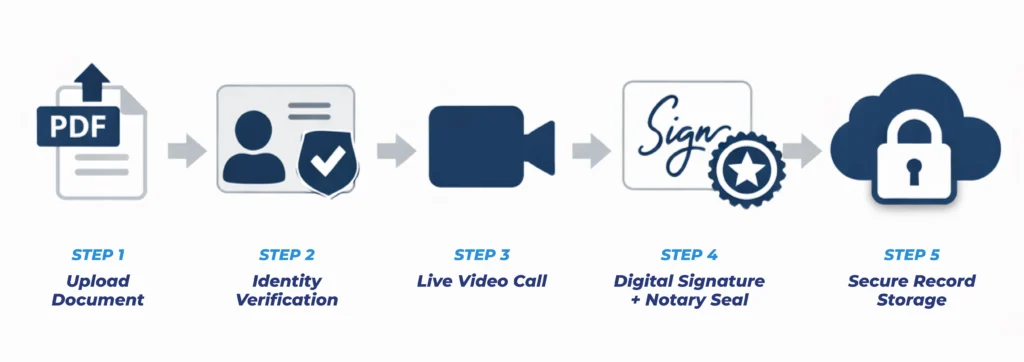
Remote online notarization follows a standardized, legally regulated workflow designed to ensure identity verification, document integrity, and compliance with state laws. While platforms may vary slightly, the core steps of the RON process remain consistent across authorized online notary services.
1. Upload the Document
The signer uploads the document that needs to be notarized to a secure online notarization platform. Documents are typically uploaded in PDF format to preserve integrity and ensure tamper resistance.
2. Verify Identity
Before the session begins, the signer’s identity is verified using approved methods such as government-issued photo identification, credential analysis, and knowledge-based authentication. These checks ensure the signer is who they claim to be and meet state legal requirements.
3. Join a Live Video Session
The signer and the online notary connect through a real-time audio-video call. During this session, the notary confirms the signer’s identity again, explains the notarization process, and ensures the signer is acting willingly and understands the document.
4. Sign and Notarize the Document
The signer electronically signs the document while the notary witnesses the action live. The notary then applies a digital signature and electronic notarial seal, completing the notarization.
5. Secure Record Storage
The entire notarization session is recorded and stored along with an audit trail, including timestamps, identity verification data, and document history. These records are retained according to state regulations and can be accessed if verification is ever required.
Is Online Notarization Legal and Valid?
Yes, online notarization is legally valid in 2026 when performed in accordance with applicable state and federal laws. In the United States, remote online notarization (RON) is authorized at the state level and carries the same legal effect as traditional, in-person notarization in jurisdictions that permit it.
When an online notarization follows state requirements, such as identity verification, live audio-video communication, secure recordkeeping, and notarial certification, the notarized document is legally enforceable. Courts, government agencies, financial institutions, and private organizations increasingly recognize and accept online notarized documents due to their strong security and audit standards.
For remote workers, this legal recognition means contracts, affidavits, authorizations, and other critical documents can be notarized online without risking rejection or compliance issues, as long as the notarization is performed by a properly commissioned online notary.
Where Is Online Notarization Accepted in 2026?
While online notarization is widely accepted, its use depends on where the notary is commissioned, not where the signer is physically located. Below is how acceptance generally breaks down in 2026.
States With Permanent RON Laws
As of 2026, 47+ U.S. states have enacted permanent remote online notarization laws. These states authorize commissioned notaries to perform notarizations remotely using approved technology platforms. In these jurisdictions, online notarization is fully recognized and enforceable under state law.
States With Restrictions or Special Conditions
A small number of states may still impose restrictions, such as:
- Limiting which documents can be notarized online
- Requiring additional identity verification steps
- Restricting notaries from serving signers located outside the United States
Because requirements vary by state, remote workers should confirm that the online notary they use is commissioned in a state that authorizes their specific notarization scenario.
Federal Government Acceptance
Many U.S. federal agencies accept online notarized documents, provided the notarization complies with state RON laws. This includes documents used for federal filings, declarations, and certain administrative procedures. However, acceptance may vary by agency and document type, so confirmation is recommended for sensitive or high-stakes submissions.
Banking and Real Estate Industry Acceptance
The banking, mortgage, and real estate industries have widely adopted online notarization. Loan documents, refinancing paperwork, powers of attorney, and real estate disclosures are commonly notarized online, especially for remote closings and multi-state transactions. These industries rely on the secure audit trails and recorded sessions that online notarization provides.
What Documents Remote Workers Can Notarize Online?
In 2026, a wide range of documents can be notarized online using remote online notarization, making it a practical solution for most professional and personal needs of remote workers. As long as the document is permitted under state RON laws and accepted by the receiving organization, online notarization carries the same legal weight as in-person notarization.
Common document categories include:
Business and work-related documents
Remote workers frequently use online notarization for independent contractor agreements, consulting contracts, non-disclosure agreements, partnership documents, and client authorizations. These documents often need to be signed quickly, making online notarization especially convenient.
Legal and personal affidavits
Affidavits, sworn statements, declarations, and consent forms are commonly notarized online. These are often required for legal proceedings, employment matters, or administrative purposes and can usually be completed in a single online session.
Financial and authorization documents
Powers of attorney, financial authorizations, loan-related forms, and banking documents are widely accepted through online notarization. Many financial institutions now support RON due to its secure identity verification and audit trail.
Real estate and property-related paperwork
Many real estate documents, including disclosures, affidavits, and certain closing documents, can be notarized online. Online notarization is especially useful for remote closings or transactions involving parties in different locations.
Immigration and international-use documents
Some immigration-related documents and forms intended for international use may be notarized online, provided the receiving authority accepts RON. Remote workers dealing with cross-border paperwork should always verify acceptance requirements in advance.
How to Choose an Online Notary Service
Not all online notary services offer the same level of reliability, security, or legal compliance. For remote workers, choosing the right provider ensures documents are notarized quickly, securely, and accepted without issues.
A good online notary service should be easy to use, transparent about pricing, and compliant with state remote online notarization laws. Availability is also important, especially for remote professionals working across time zones or outside standard business hours.
How Much Will Online Notary Cost in 2026?
The cost of online notarization in 2026 varies based on state regulations, document type, and service provider. Most online notary platforms charge per notarized document or per notarial act, with pricing designed to reflect the convenience and security of remote notarization.
For remote workers, online notarization is often more cost-effective than in-person services when factoring in time saved, travel costs, and scheduling flexibility.
Average Online Notary Costs in 2026
| Notarization Type | Typical Cost Range | Notes for Remote Workers |
| Single online notarization | $20 – $30 | Common for contracts, affidavits, and authorizations |
| Multiple notarizations (same session) | $25 – $50 | Often discounted when notarizing several documents |
| Real estate or loan documents | $25 – $75 | Pricing may vary by state and document complexity |
| 24/7 or on-demand notarization | $25 – $40 | Higher availability may slightly increase cost |
| Traditional in-person notarization | $5 – $15 | Lower fee, but excludes travel and time costs |
What Affects Online Notary Pricing?
While in-person notarization may appear cheaper upfront, online notarization often delivers better overall value for remote workers who prioritize speed, flexibility, and minimal disruption.
This broad adoption reflects the long-term shift toward digital-first legal processes and has made online notarization a standard option rather than an exception.
How to Get Started With Online Notarization
Getting started with online notarization in 2026 is simple and requires very little preparation. Remote workers can complete the entire process in one short session without printing documents or scheduling in-person appointments.
To begin, choose an online notary service that operates in a state with active remote online notarization laws. Upload the document that needs to be notarized, verify your identity using a government-issued ID, and join a secure video session with a commissioned online notary. Once the document is signed and notarized, you’ll receive a legally valid digital copy, often within minutes.
For remote workers handling time-sensitive documents, online notarization offers a fast, reliable way to complete paperwork without disrupting work schedules or travel plans.
Frequently Asked Questions
Is online notarization as legally valid as in-person notarization?
Yes. When performed in compliance with state remote online notarization laws, online notarization carries the same legal validity as traditional notarization.
How long does an online notarization take?
Most online notarizations are completed within 10–15 minutes, depending on document type and identity verification requirements.
Can I notarize documents if I am outside the United States?
In many cases, yes. As long as the online notary is properly commissioned in an authorized U.S. state and the receiving organization accepts RON, documents can often be notarized while you are abroad.
Do online notarizations require printing documents?
No. Online notarization is completed digitally, eliminating the need to print, scan, or mail documents.
Is my online notarization session recorded?
Yes. Online notarization sessions are recorded and stored securely as part of the legally required audit trail.
It’s Time To Notarize Your Documents From the Comfort of Your Home
Online notarization has become a practical, legally recognized solution for remote workers in 2026. By eliminating geographic barriers, reducing time spent on administrative tasks, and providing secure digital records, online notaries support the flexibility and speed modern work demands.
For remote professionals managing contracts, authorizations, or time-sensitive documents, online notarization offers a reliable alternative to traditional in-person services. When used through a compliant platform, it combines convenience, security, and legal validity, without disrupting your workday.
If your next document needs notarization, using an online or mobile notary can help you get it done quickly, securely, and from wherever you work.