
Green Card vs Visa
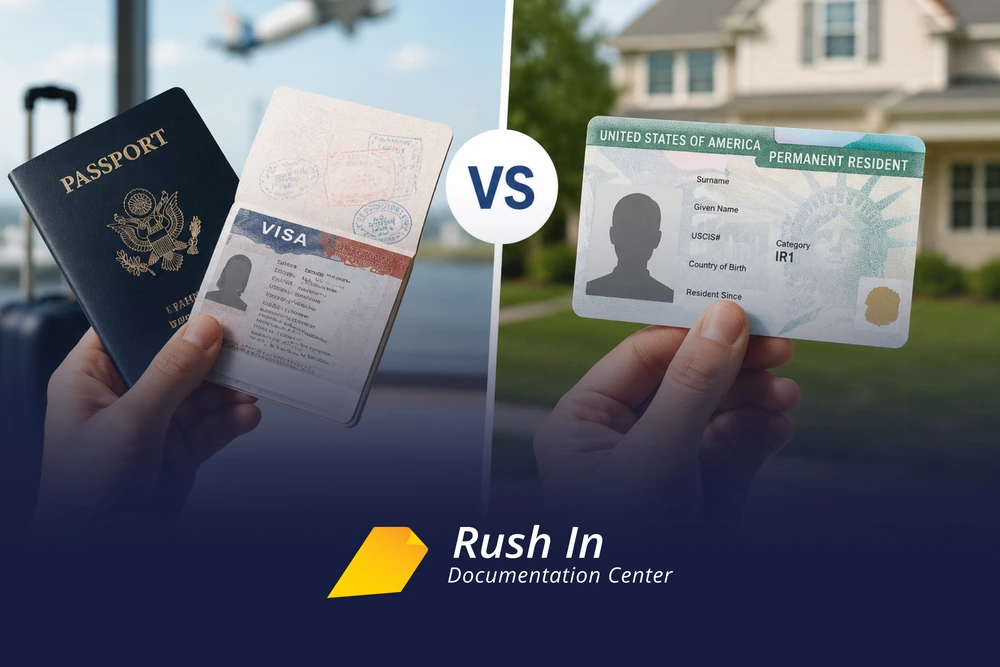
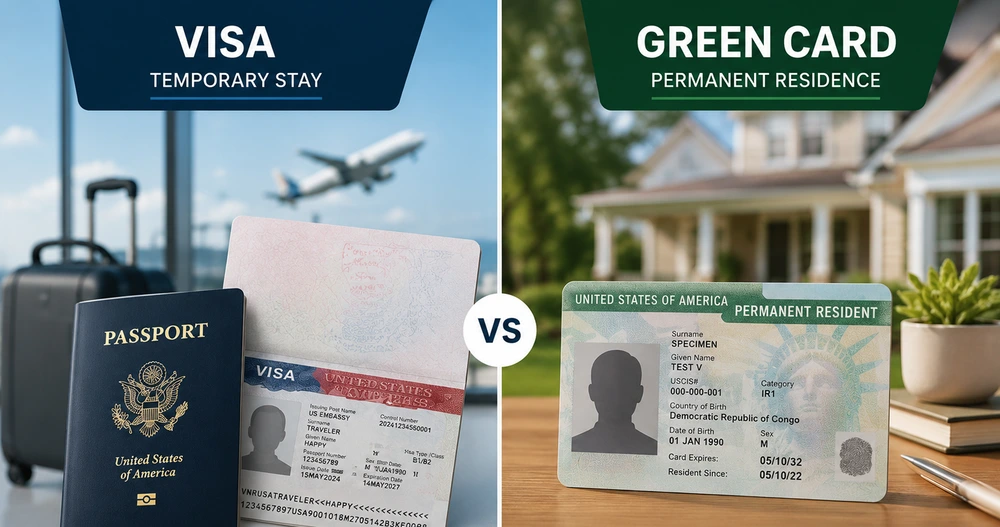
A visa grants temporary permission to enter or stay in the United States. A green card grants permanent residence. A visa is an entry document tied to a specific purpose and end date. A green card is a status that lets you live and work here indefinitely, with a path to citizenship.
Which one you need comes down to how long you plan to stay, whether you need to work, and whether citizenship is the goal. Whatever the route, US applications fail on paperwork far more often than on eligibility, so getting your documents ready for USCIS submission matters from the first form.
| Visa | Green card | |
| What it is | Entry document, not a status | Lawful permanent resident status |
| Purpose | Temporary entry for a set reason | Permanent residence in the US |
| Duration | Fixed term tied to category | Indefinite, card renews every 10 years |
| Who issues it | US Department of State (consulates) | USCIS (Form I-551) |
| Work rights | Only if the visa category allows it | Yes, for almost any employer |
| Travel | Re-entry follows visa validity and I-94 | Re-enter freely, with limits on long absences |
| Renewal | Reapply or extend before expiry | Renew the card with Form I-90 |
| Path to citizenship | No, not on its own | Yes, after the required residence period |
| Loss of status risk | Overstay, violation, denied re-entry | Abandonment, certain crimes, fraud |
Contested figures and rules in the tables below are sourced to USCIS and travel.state.gov.
What is a visa?
A US visa is an entry document, not a status. It is placed in your passport and lets you request admission at a port of entry. It does not, by itself, set how long you can stay. That is controlled by your I-94 record, issued by Customs and Border Protection (CBP) when you are admitted. Your visa can be valid for years while your authorized stay runs only months, so the two dates are separate and the I-94 is the one that governs how long you may remain.
The State Department issues visas in more than 80 categories, split into two groups: nonimmigrant visa and immigrant visa.
What is a nonimmigrant visa?
A nonimmigrant visa is for a temporary purpose: tourism, study, temporary work, business, or exchange. For most of these categories, the law presumes you intend to return home. Under INA 214(b), a nonimmigrant applicant must overcome the presumption of immigrant intent, which is why consular officers ask about ties to your home country.
What is an immigrant visa?
An immigrant visa is for someone who intends to live in the US permanently. You apply for it through consular processing abroad on Form DS-260. When you enter the US on an approved immigrant visa, you become a permanent resident, and your green card is mailed to you afterward.
| Visa | Purpose | Typical validity |
| B-2 | Tourism, visiting | Up to 6 months per entry (I-94 controls) |
| F-1 | Academic study | Duration of program (D/S) |
| H-1B | Specialty occupation work | Up to 3 years, extendable to 6 |
| L-1 | Intracompany transfer | 1 to 3 years, extendable |
| K-1 | Fiancé(e) of a US citizen | Single entry, marry within 90 days |
What is a green card?
A green card, officially Form I-551, makes you a lawful permanent resident. You can live and work here, sponsor certain family members, and apply for citizenship after meeting the residence requirement. The card itself is valid for 10 years and is renewed with Form I-90. A conditional green card (issued, for example, through a recent marriage) lasts two years and requires Form I-751 to remove the conditions.
Permanent residence carries duties, not just rights. You must file US taxes on worldwide income, report address changes within 10 days on Form AR-11, and, if you are male and aged 18 to 25, register with the Selective Service. Long trips abroad can put your status at risk, so a reentry permit (Form I-131) is worth filing before an extended absence.
| Rights | Responsibilities |
| Live and work in the US permanently | File US taxes on worldwide income |
| Sponsor certain family members | Report address changes within 10 days (AR-11) |
| Travel in and out of the country | Register for Selective Service (males 18 to 25) |
| Apply for citizenship when eligible | Maintain residence, avoid abandonment |
Can you lose a green card?
Yes. Permanent residence is not unconditional. You can lose it by abandoning residence through long or repeated trips abroad, by certain criminal convictions, or by fraud in the original application. Spending extended time outside the US without a reentry permit is the most common avoidable risk, because it signals you no longer intend to live here.
Can a visa become a green card?
Often, yes, depending on the visa and your situation. The dividing line is intent.
What is dual intent?
Most nonimmigrant visas assume you will leave when your stay ends, so openly planning to immigrate can sink your application under INA 214(b). A few categories allow dual intent, meaning you can hold the temporary visa and pursue permanent residence at the same time without contradiction. H-1B and L-1 are the main dual-intent visas, which is why they are common stepping stones to a green card.
What are the main paths from visa to green card?
Four routes cover most cases. You either adjust status inside the US on Form I-485 or process your immigrant visa abroad on Form DS-260.
| Route | Who qualifies | Key form | Typical wait |
| Family | Spouse, parent, child, sibling of citizen or resident | I-130, then I-485 or DS-260 | Months to many years, by category |
| Employment | Worker sponsored by a US employer | PERM, I-140, then I-485 or DS-260 | 1 to several years |
| Diversity lottery | Selected applicants from eligible countries | DS-260 (DV) | One fiscal year window |
| Asylum or refugee | Granted protection, then 1 year later | I-485 | 1 year after grant, plus processing |
What documents do you need for a visa vs a green card?
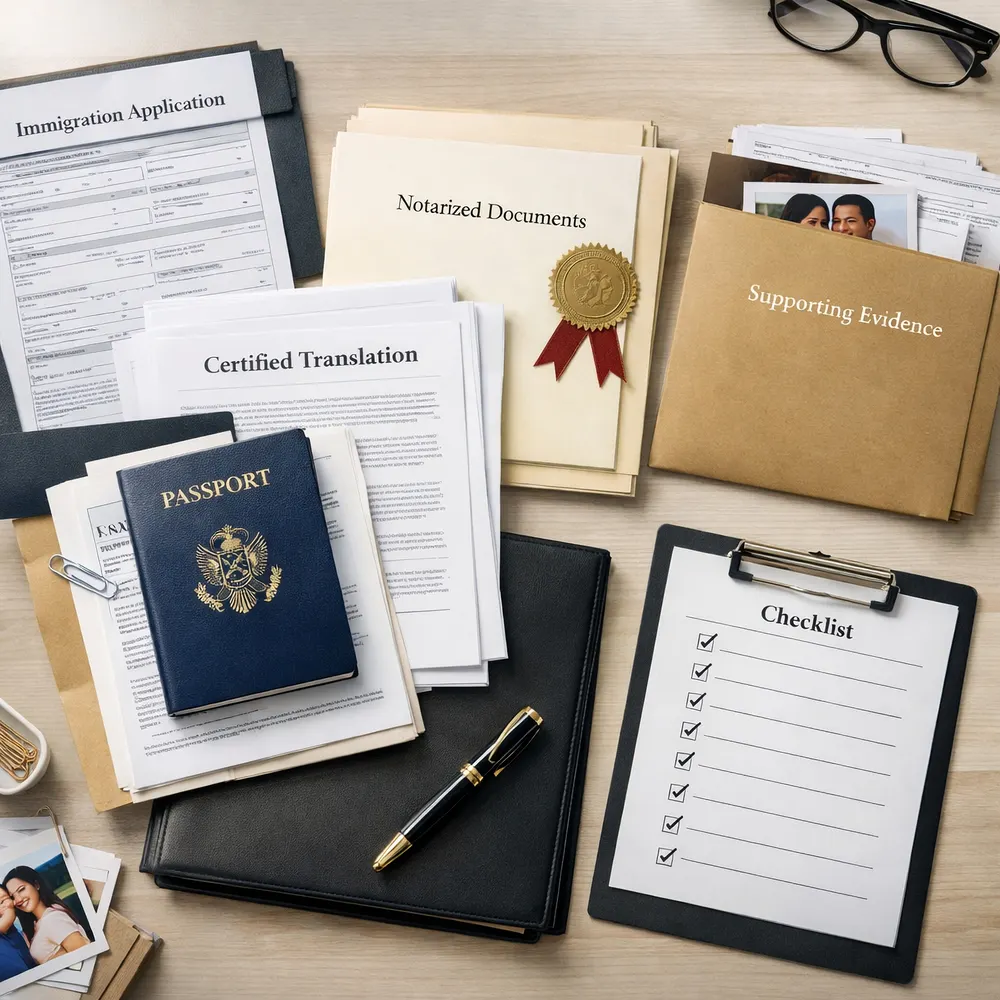
This is where most applications stall. Eligibility is rarely the problem; missing, mismatched, or untranslated paperwork is. Here is what each path generally requires, side by side.
| Document | Visa application | Green card application |
| Valid passport | Required | Required |
| Application form | DS-160 (nonimmigrant) | I-485 or DS-260 |
| Petition (if sponsored) | Approved petition (e.g. I-129) | I-130 or I-140 |
| Photos to spec | Required | Required |
| Civil documents (birth, marriage) | As requested | Required |
| Police certificates | Often required | Required |
| Medical exam | Not usually | Form I-693 |
| Financial support evidence | Sometimes | Affidavit of support |
| Certified English translations | For foreign-language docs | For foreign-language docs |
Any document in a foreign language must include a full English translation, and under 8 CFR 103.2(b)(3) the translator must certify that it is complete and accurate and that they are competent to translate. A birth or marriage certificate from abroad is not usable as submitted; it needs a certified translation first. Apostilles or police certificates from your home country may also need handling before they are filed.
What Rush In handles in this stack
- certified translations
- document preparation
- notarization
All is done locally so foreign and civil documents are filed in a form USCIS accepts the first time.
FAQ
Is a green card a visa?
No. They are different things. A visa is a temporary entry document issued by the State Department for a specific purpose. A green card is lawful permanent resident status issued by USCIS. A visa lets you enter for a set time; a green card lets you live here permanently.
Can I stay in the US with an expired visa but a valid I-94?
Often yes. Your visa is only the entry document; your I-94 record controls how long you may remain. If your visa expired after you were admitted but your I-94 is still valid, you can usually stay until the I-94 date. You will need a valid visa to re-enter, though.
How long can I stay outside the US with a green card?
Trips under six months are generally fine. Absences over six months can raise questions about abandonment, and a year or more can be treated as giving up residence. File a reentry permit (Form I-131) before any long trip abroad to protect your status and your path to citizenship.
Is a green card better than a visa?
Neither is better; they serve different needs. A green card wins if you want to stay permanently, work freely, or pursue citizenship. A visa is the right tool for a temporary, defined purpose like study, a work assignment, or a visit, and it is far cheaper and faster to obtain.
Can I work in the US on a visa?
Only if the visa category allows it. Work visas like H-1B and L-1 permit employment, usually tied to one sponsoring employer. Tourist and most student visas do not allow general work. A green card, by contrast, lets you work for almost any employer without separate authorization.
Does a green card expire?
The card expires, but your status does not. A standard green card is valid for 10 years, and you renew the card itself using Form I-90. A conditional two-year card requires Form I-751 to remove conditions. Letting the card lapse does not end your residence, but renew it promptly.