Who Can Certify a True Copy of an Original Document in the U.S.?
In the United States, a notary public, a licensed attorney, or the government agency that issued the document can certify a true copy of an original. Which one you need depends on the document. Notaries can certify copies of many private documents like diplomas, contracts, and powers of attorney, though state rules on copy certification by notaries vary widely. Attorneys can certify copies for litigation and international filings. Vital records, birth certificates, marriage certificates, death certificates, and U.S. passports can only be certified by the government agency that issued them.
Getting this wrong is one of the most common reasons applications get rejected. Immigration cases, university admissions, foreign employment filings, and overseas property transactions all turn on submitting the right type of copy. The wrong stamp on the wrong paper can delay a case by weeks or months.
Who can certify a true copy of an original document?
In the United States, the answer depends on the document and the receiving authority. In most states, a notary public can certify a true copy of certain private documents such as diplomas, contracts, and powers of attorney. U.S. passports, birth certificates, marriage certificates, and other vital records can only be certified by the issuing government agency. Attorneys, court clerks, and certain government officials are also authorized to certify copies for specific purposes.
Certification Authority by Use Case
Before we look at each authority in detail, the table below maps the most common use cases to the right certifier. As you will see, no single authority works for every situation.
| Use Case | Who Can Certify | What to Avoid |
| Private documents (contracts, diplomas, POAs) | Notary public (in most states) | Bank tellers, employers |
| U.S. passport | U.S. Department of State only | Notary “copy certifications” |
| Birth, marriage, death certificates | Vital records office of issuing state | Notary certifications |
| Court records | Clerk of the issuing court | Notary certifications |
| Immigration filings (USCIS) | Issuing agency, or photocopy of original | Notarized copies in most cases |
| Apostille (international use) | Authority based on document type | Self-certification |
| University transcripts | Registrar’s office of the school | Third-party copies |
Now, let us look at each one more closely.
What Is a Certified True Copy?

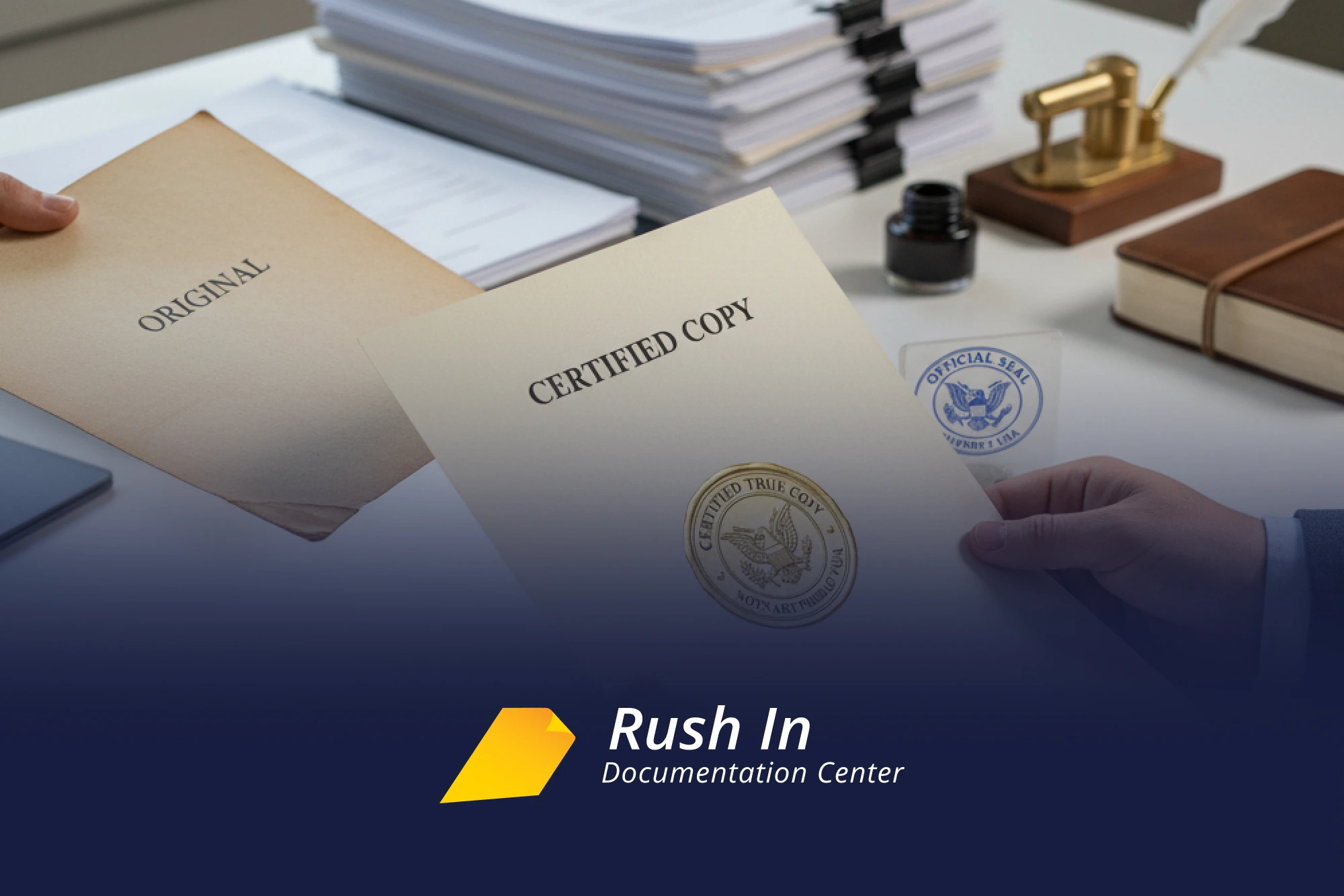
A certified true copy is a photocopy of an original document that has been verified by an authorized person. The certifier compares the copy to the original, confirms that the two match, and then signs and stamps the copy.
This single act tells the receiving authority three things. An original document exists. The copy is a complete and accurate reproduction of that original. And the certifier personally saw both the original and the copy at the same time.
Certified true copies are useful when you cannot or do not want to surrender the original. Universities, immigration offices, courts, and foreign governments all use certified copies to verify documents without keeping them.
How Certification is Different from Notarization
This is where most clients get confused. Notarization and certification are related, but they are not the same.
A notary public performs several different acts. Some are acknowledgments, which confirm that a person signed a document willingly. Others are jurats, which confirm that a person swore to the truth of a statement under oath. Copy certification is a separate notarial act, and it is not allowed in every state.
A “notarized document” is not automatically a certified true copy. The notary may have only witnessed a signature. If you need a certified copy, you have to ask for that specific service, and the certified true copy stamp will say so directly on the document.
What the Certifying Party Is Actually Confirming
When an authorized person signs a certified true copy, they are not vouching for the content of the document. In fact, they make no claim about whether the document is genuine, legal, or accurate.
What they are confirming is much narrower. To clarify, the certifier states that they have seen both the original and the copy. They also confirm that the copy is a true and complete reproduction of the original at the time of certification. Nothing more, nothing less.
This is an important point. For example, a notary can certify a copy of a fake diploma, and the certification is still valid as a statement of comparison. The receiving authority is responsible for verifying the underlying document. The certifier only verifies the copy.
Who Is Authorized to Certify True Copies in the U.S.?
In the United States, there is no single national authority for certifying copies. Instead, the power is split among several parties. Each one has different limits, and each is recognized for different purposes.
That said, four main groups of certifiers handle the bulk of all copy certifications nationwide. We will look at each in turn.
Notaries Public
A notary public is the most common certifier of true copies in the United States. However, the authority to certify copies varies by state, which is a detail many people miss.
To begin with, states such as California, Texas, and Arizona allow notaries to certify true copies, but only for certain documents. In California, for example, notaries can only certify copies of powers of attorney and copies of their own notarial journals. This rule comes from California Government Code Section 8205. Other states, such as Florida and Pennsylvania, allow notaries to certify copies of a wider range of documents.
In contrast, some states do not authorize notaries to certify copies at all. In those states, the notary can instead notarize an affidavit signed by the document holder, who swears that the attached copy is a true reproduction. This is known as a copy certification by document custodian. For clients in California, a licensed mobile notary can come to your location for copy certification of eligible documents and other notarial acts.
Attorneys and Legal Professionals
In many U.S. states and in most common-law countries, attorneys are also authorized to certify true copies. This is especially common for international filings.
The exact rules depend on the jurisdiction. In some states, an attorney’s certification carries the same weight as a notary’s. In others, the attorney must also be a commissioned notary to certify copies. As a result, when in doubt, applicants should ask the receiving authority which form of certification is accepted.
Attorneys often certify copies for litigation, real estate closings, estate planning, and corporate filings. In addition, foreign embassies frequently accept attorney certifications on documents intended for use abroad, particularly in countries with a strong legal tradition of solicitor-certified copies.
Government Officials and Agency Representatives
For certain documents, only a government official can issue a valid certified copy. This is the rule that catches most people off guard.
For example, only the vital records office of the issuing state can produce a certified copy of a birth certificate, marriage certificate, or death certificate. Similarly, only the clerk of court can certify court records, only the U.S. Department of State can certify a U.S. passport, and only the issuing university can certify an official transcript.
In each case, the rule exists for a reason. These documents carry legal weight that depends on a direct chain of custody from the issuing authority. A notary or attorney certification, no matter how proper, does not satisfy that chain. As a result, the receiving authority will reject it.
What About Banks, Doctors, and Employers?
A common assumption is that bank tellers, doctors, or HR managers can certify copies because they handle sensitive documents every day. In most cases, this is incorrect under U.S. law.
To clarify, in some Commonwealth countries, professionals like bankers, doctors, and pharmacists are recognized certifiers. However, in the United States, this practice is not standard. A bank notary may notarize a signature. However, unless that person is acting in their notary capacity and the state allows copy certification, they cannot issue a certified true copy.
For this reason, when a U.S. agency asks for a certified copy, the safest path is to use a notary, an attorney, or the issuing authority. Asking a bank manager to “stamp” a copy is unlikely to be accepted by USCIS, a court, or a foreign embassy.
Documents That Cannot Be Certified by a Notary
This is the part of the topic that causes the most rejected applications. Some documents look like ordinary paperwork but carry special legal protections. As a result, only the issuing government agency can produce a valid certified copy.
A notary stamp on these documents has no legal effect for official purposes. In fact, in some cases, attempting to certify these copies as a notary can violate state law.
U.S. Passports
A U.S. passport is a federal document issued by the U.S. Department of State. As such, it falls outside the authority of any state-commissioned notary.
To clarify, in most states, notaries are explicitly prohibited from certifying copies of U.S. passports. The reason is straightforward. The passport is a federal identity document, and certification authority over federal records is reserved to federal agencies.
Furthermore, allowing notary certification of passport copies would create a security risk that the State Department has explicitly addressed.
If you need a certified copy of a U.S. passport, the correct path is to request one from the State Department’s Vital Records office. The process involves Form DS-1000 and a fee. There is no notary shortcut for this document.
Birth Certificates, Marriage Certificates, and Vital Records
Vital records are issued by the state where the event occurred. Birth certificates come from the state of birth. Marriage certificates come from the state where the marriage was registered. Death certificates come from the state where the death occurred.
In every case, only the vital records office of that state can issue a certified copy. A notary cannot certify a copy of a birth certificate, no matter how clearly the original matches the copy. The receiving authority, such as USCIS, will reject the document.
This is the single most common mistake we see in document preparation. Clients arrive with a notarized photocopy of a birth certificate, thinking the matter is settled. In fact, they need to order a fresh certified copy from the state vital records office, which is a separate process entirely.
How to Get a Certified Copy of These Documents
The process for ordering a certified copy of a vital record is straightforward, but it takes time. To begin with, you must contact the vital records office of the state where the event was registered. Most states allow online ordering through services like VitalChek, as well as mail-in requests and in-person pickup at the state office.
In most cases, you will need to provide proof of identity and proof of your relationship to the person named on the record. There is also a fee, which typically ranges from $15 to $35 per copy. Processing times vary widely. For example, online expedited orders may arrive in 5 to 7 business days, while standard mail orders can take 6 to 12 weeks.
For this reason, if you have an upcoming deadline, order the certified copy as soon as you know you need it. If the record also needs to go abroad, the apostille and legalization process adds another layer of time that should factor into your plan.
How the Certification Process Works, Step by Step
For documents that can be certified by a notary, the process itself is quick and clear. Knowing what to expect will save you a wasted trip.
The notary needs three things to certify a copy. These are the original document, a clean photocopy, and a valid photo ID from the person requesting the certification. Without all three, the notary cannot proceed.
What to Bring to a Notary for Document Certification
To prepare for your appointment, gather the following items in advance:
- The original document in good condition (no missing pages, no major damage)
- A clear, complete photocopy of the original
- A valid government-issued photo ID, such as a driver’s license or passport
- Payment for the notary fee
- Any specific forms required by the receiving authority
In addition, some receiving authorities require the certification to use specific wording.
For example, foreign consulates often have their own preferred certification language. For this reason, it is always a good idea to ask the receiving party what they expect before you go to the notary.
What the Notary Checks and Signs
Once you arrive, the notary follows a defined process. First, the notary verifies your identity using your photo ID and records your information in their journal. Next, they compare the photocopy to the original page by page, looking for differences in content, layout, or completeness.
If the copy matches the original, the notary attaches a certification statement, signs it, and applies the official notary seal. The statement typically reads something like this: “I certify that this is a true and correct copy of the document presented to me.”
Importantly, the notary keeps no record of the document itself. Furthermore, they do not retain the copy or the original. Both stay with you. The journal entry only records the date, the act performed, and your identification.
How Long It Takes and What It Costs
A standard copy certification by a notary takes between 5 and 15 minutes per document. As a result, this is one of the fastest notarial acts available.
Notary fees for copy certification are set by each state. For example, California allows up to $15 per certified copy. Florida allows up to $10. Texas allows up to $10 for the first copy and $1 for each additional copy of the same document. Most other states fall in a similar range.
In addition, if you use a mobile notary who travels to you, expect to pay a separate travel fee on top of the per-copy charge. The travel fee is not capped by state law and varies by distance, time of day, and urgency. For a full breakdown of what a mobile notary typically charges in Los Angeles, see our pricing guide.
Certified Copies for International Use: Apostille and Legalization
If your document is going to a foreign country, a certified copy is often only the first step. After that, the document usually needs an additional layer of authentication.
The second step depends on the destination country. There are two main paths: apostille and legalization. Each path follows different rules.
When a Certified Copy Is Only the First Step
For international use, the receiving country needs proof that the certifier was actually authorized to certify the document in the United States. A notary stamp from a small town in California means little to a government office in Italy or Brazil. As a result, an additional level of authentication is required.
This second level of authentication comes from the Secretary of State of the state where the notary is commissioned. The Secretary of State confirms that the notary’s commission was valid on the date of certification. In some cases, an additional certification from the U.S. Department of State is also required.
The Difference Between Certification, Apostille, and Legalization
These three terms are often confused. Each refers to a different stage of the same overall process.
Certification is the first stage. A notary, attorney, or government official confirms the document is a true copy of the original.
Apostille is the second stage for countries that are part of the 1961 Hague Apostille Convention. The Secretary of State adds an apostille certificate to the document. Once an apostille is attached, the document is accepted in any other Hague Convention country without further steps.
Legalization is the second stage for countries that are not part of the Hague Convention. In such cases, the document must be authenticated by the foreign country’s embassy or consulate in the United States. This process takes longer and involves more fees.
For example, a document going to Spain (a Hague country) needs certification and apostille. A document going to Saudi Arabia (a non-Hague country) needs certification, U.S. Department of State authentication, and Saudi consular legalization. To see how the full chain works in practice, the team that prepares documents for international use handles every step from notarization through embassy legalization.
Certified Copies for Immigration: What USCIS Accepts
USCIS has its own rules for certified copies, and these rules surprise many applicants. In most cases, USCIS does not require a notarized or attorney-certified copy at all.
Instead, USCIS asks for either the original document or a plain photocopy of the original. The applicant submits the copy with the expectation that USCIS may ask to see the original at a later interview.
When You Need a Certified Translation vs. a Certified Copy
The two terms sound alike, but they describe very different services. A certified copy confirms that a photocopy matches the original document. A certified translation confirms that an English translation matches the foreign-language original. They serve different purposes, and USCIS requires the second one far more often than the first. For the full list of certified translation requirements for USCIS filings, check the service page before you order.
In fact, under 8 CFR 103.2(b)(3), any foreign-language document submitted to USCIS must include a full English translation by a competent translator. The translator must sign a statement attesting to their competence and the accuracy of the translation.
Documents USCIS Will Not Accept as Notarized Copies
In most cases, USCIS will not accept a notarized photocopy as a substitute for an original document. This catches many applicants off guard.
For example, applicants often arrive at a USCIS interview with a notarized copy of their birth certificate. They assume the notary stamp gives the copy official weight. In fact, USCIS treats it as just a photocopy. If USCIS wants to verify the document, they will ask for the original certified copy. This must come from the vital records office of the state of birth.
For this reason, the safer path is to order fresh certified copies from the issuing authority well in advance. In addition, keep originals in a safe place and bring them to all interviews. A notary stamp does not substitute for a government-issued certified copy of a vital record.
Frequently Asked Questions
Can a notary certify a copy of a passport in the U.S.?
In most cases, no. U.S. passports are federal documents, and most state notary laws prohibit notaries from certifying copies of them. For a certified copy of a U.S. passport, you must contact the U.S. Department of State directly using Form DS-1000.
What is the difference between a notarized copy and a certified copy?
A certified copy confirms that a photocopy matches an original document and is issued by an authorized certifier. A notarized copy can mean different things. In some states, it is the same as a certified copy. In others, it is simply an affidavit signed by the document holder and witnessed by a notary. Always ask which one the receiving authority requires.
Can I certify my own documents?
No, you cannot certify your own documents in any U.S. state. Certification must come from a third party authorized by law, such as a notary public, an attorney, or the issuing government agency. In states that allow copy certification by document custodian, you can sign an affidavit swearing the copy is true. However, a notary must still witness the signature.
How do I get a certified copy of a birth certificate?
You order it from the vital records office of the state where the birth was registered. Most states allow online, mail, or in-person requests. Fees usually range from $15 to $35 per copy. Standard processing can take 6 to 12 weeks, while expedited online orders often arrive in 5 to 7 business days.
Does USCIS accept notarized copies of documents?
In most cases, no. USCIS prefers the original document or a plain photocopy with the original available at interview. For vital records, USCIS expects a certified copy from the issuing state agency. A notary stamp on a photocopy does not substitute for an official certified copy.
Can a lawyer certify a true copy?
In many states and most common-law countries, yes. An attorney can certify a true copy of certain documents, especially for international filings. The exact authority depends on state law and the rules of the receiving party. When in doubt, ask the receiving authority whether attorney certification is accepted.
How much does it cost to get a document certified?
Notary fees for copy certification are set by state. For example, the cap is $15 per copy in California, $10 in Florida, and $10 for the first copy in Texas. Mobile notaries add a separate travel fee. Attorney certifications and government-issued certified copies have their own pricing structures.
What does “certified true copy” mean on an immigration form?
It means a photocopy of the original document that has been verified by an authorized party. For immigration filings, the receiving authority usually specifies the type they want. Vital records require a state-issued certified copy. Private documents may need a notarized or attorney-certified copy. Always check the specific form instructions before submitting.